

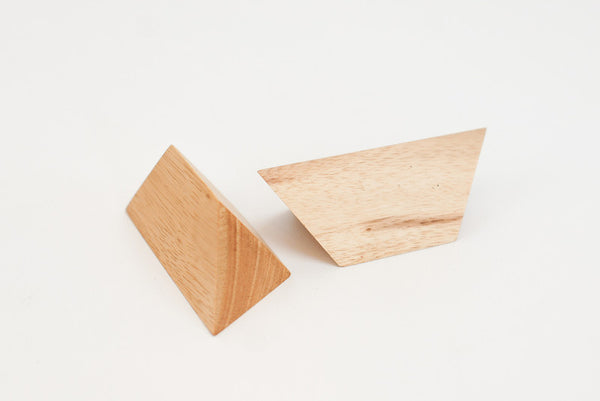
2 Piece Pyramid - Wooden Puzzle
$2.99
A puzzler's first test: can you assemble these identical pieces into a solid triangular based pyramid?

3 Boxy
$20.99
Puzzle design by Vin&Co from Czech Republic, designer Vaclav Obsivac.
Goal:
Take apart and put together.
- Size: 9x9x5
- Pieces: 6
- Difficulty: 4
- Wood: various wood
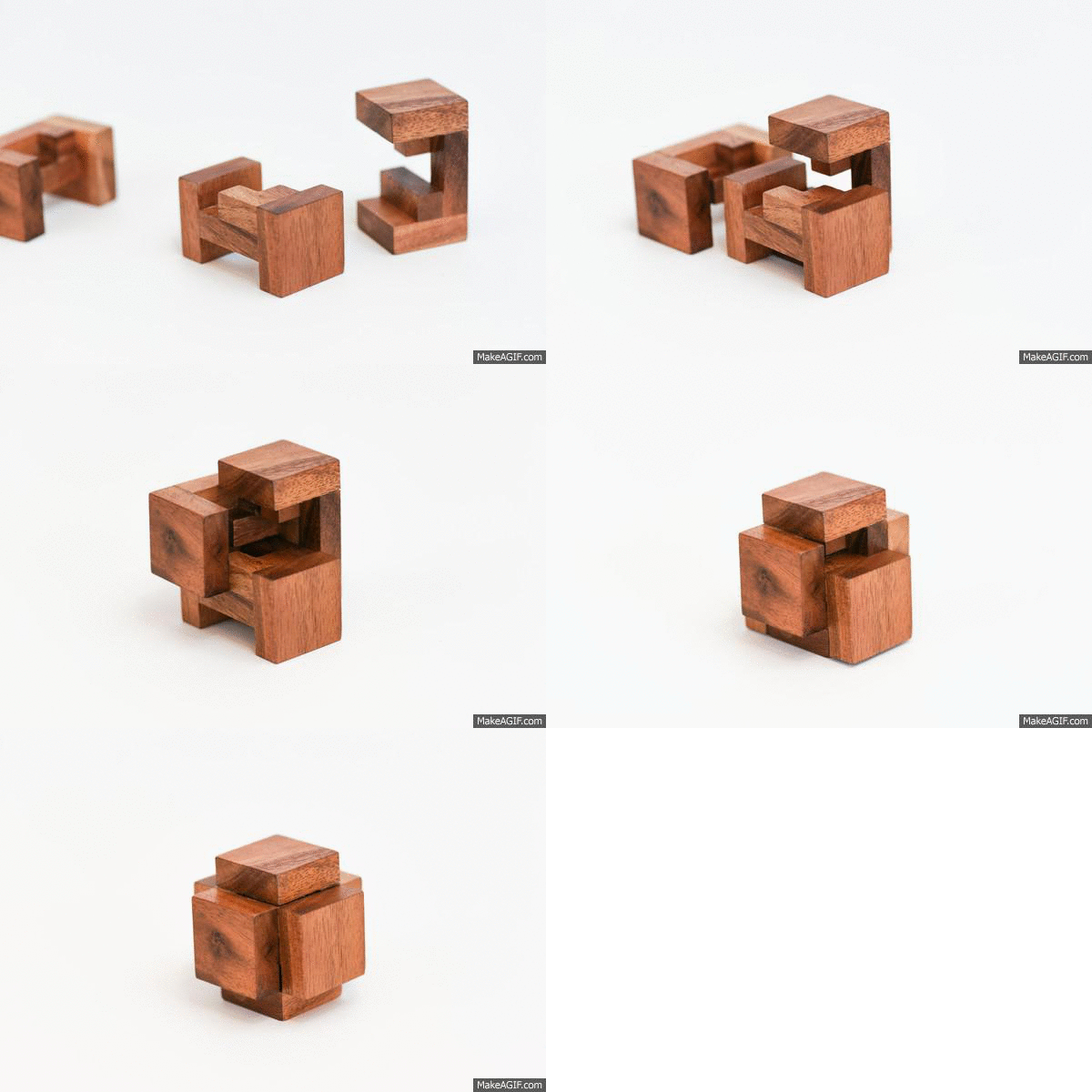
3 Pieces Burr - Brain Teaser Wooden Puzzle
$6.00
This puzzle contains 3 un-identical pieces.
Try to assemble the pieces to a 3D puzzle.

4x4 Creative Cube
$13.50
Creative Cube
It's easy to take apart ... But now, can you turn it back into a cube?
Each separate cube can turn in 3 different directions, this gives the opportunity to build other amazing shapes/ animals.
A fun toy alternative to the snake cube puzzle!
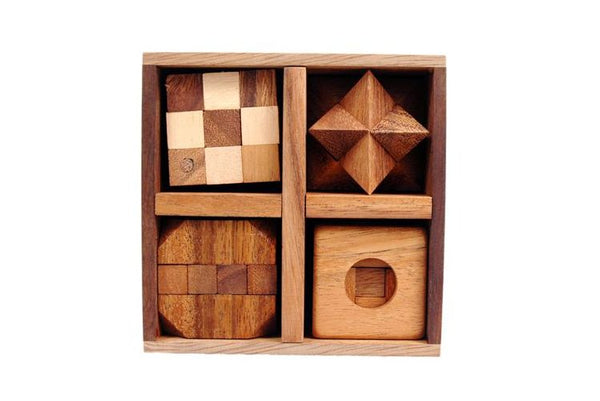
5 Brain teasers in a box
Sold Out
There are 5 puzzles in one tricky box:
- Soma cube
- Snake cube
- Star puzzle
- Mad X
- Diamond cube

Crazy 8
$16.00
The object of the game is to arrange the eight cubes to form one large cube, with each of its six faces showing all four colors (red, green, yellow and blue). Note that white is referred to as "unpainted" and will be hidden once the final large 2x2x2 cube is assembled. This can help you get started. Feel free to move any little cube to any position within the large one, and to rotate the little ones any way you see fit.
For solution follow this link:
https://cdn.shopify.com/s/files/1/0181/8685/files/Instructions_5.pdf?v=1657167759
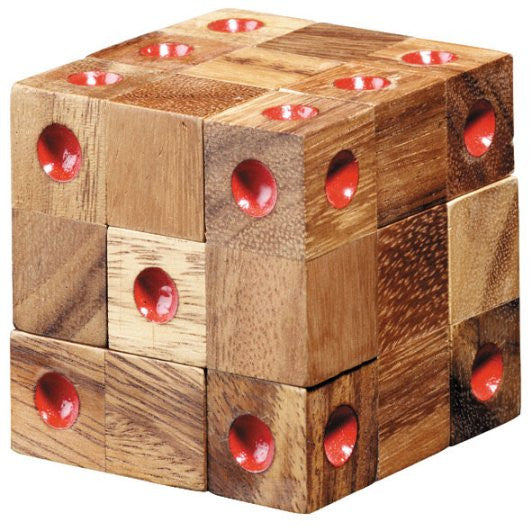
Domino Cube - Wooden Puzzle
$15.00
Composed of 9 pieces. You need to assemble them to a cube, or a dice with red/green dots.
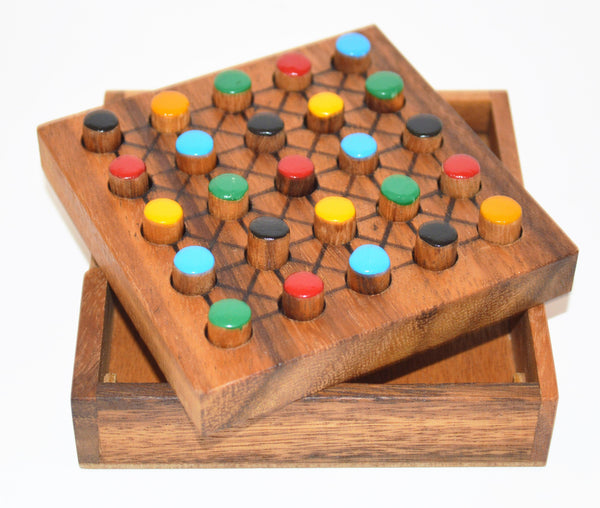
Five Different - Wooden Brain Teaser
Sold Out
Five Different
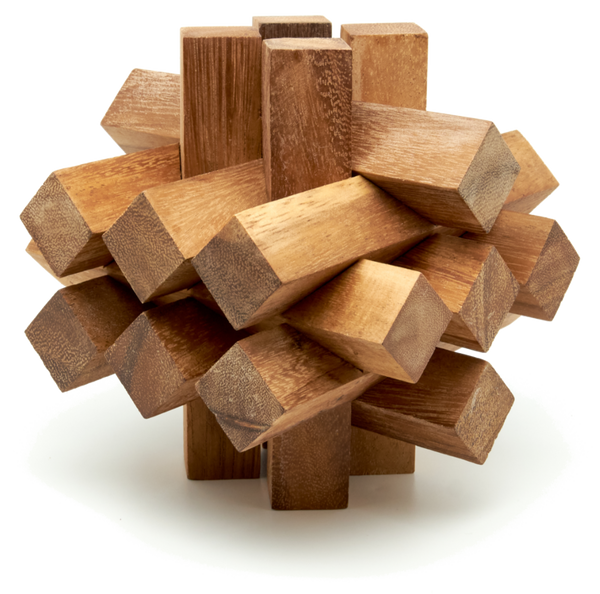
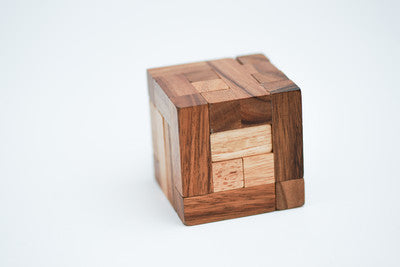
Koncy Wooden Puzzle - Brain Teaser
$12.00
This dynamic cube is one of our hardest, and also happens to be one of our favorites. The Koncy Puzzle contains six pieces. Nothing connects these pieces to each other, or lets the cube retain its form, besides the unique and unconventional shapes of the pieces themselves. Dismantling this cube is a very complex and gentle affair. It should be done one step at a time, and is difficult in and of itself.
The 6 pieces slide apart and return to a cube. It is important to note the last piece to come apart as it is the last to be inserted as the cube is reassembled.
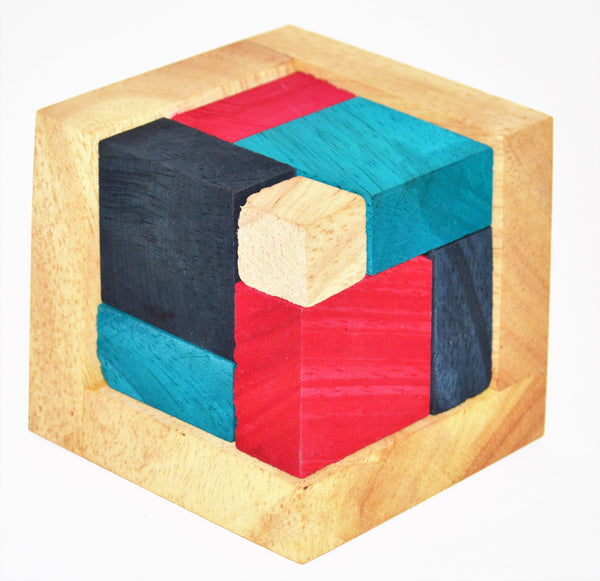
Leaning Pyramid - Wooden Puzzle
$7.00
This mind bending puzzle is beautiful in its simplicity and leaves even the most experienced puzzler feeling dizzy.
Take out all 9 pieces and try to rebuild the leaning cube. When the puzzle is done all six faces of the completed cube show the same pattern, for the packed puzzle is totally symmetrical.
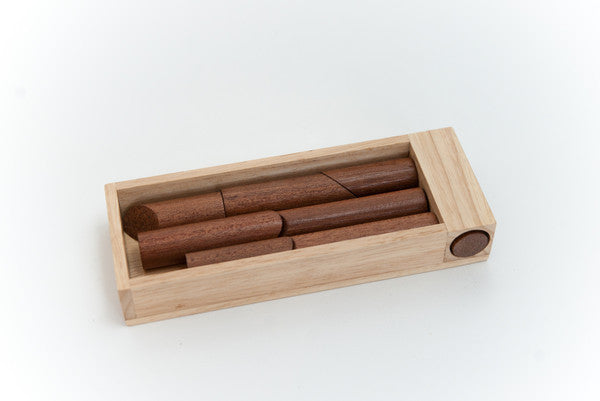
Logs Puzzle - Wooden Packing Problem
$6.00
This clever puzzle has an elegant solution, and makes a wonderful gift for any visual thinker!
Inside a wooden frame are 7 cylindrical pieces, of different lengths. In the side of the frame is an indentation containing an additional piece. Rearrange all 8 pieces so that they lie flat inside the frame.
A real stumper!
You can find solution here:
https://cdn.shopify.com/videos/c/o/v/f4551c240fd7438483c9bad90e152f46.mov
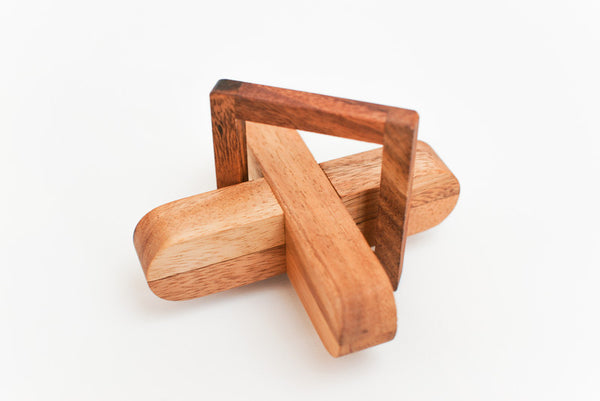
Mad X - Brain Teaser Wooden Game
Sold Out
This ingenious riddle has always been a hit in our stores. The concept for this puzzle was first developed centuries ago, and has been implemented in countless ways since then.
Try to release the wooden frame from the two pieces of wood. The inner part of the wooden pieces is locked by four pins, when you shake the game you can hear them. Think of an effect that can cause the pins move out of the way at the same time.
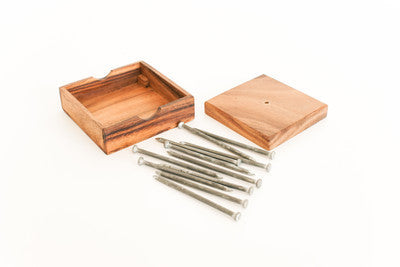
Nails Enigma - Brain Teaser Puzzle
Sold Out
The challenge :Balance all the nails on the single peg in the center without letting the nails touch the base!
You may not use rubber band, glue or any other aids…
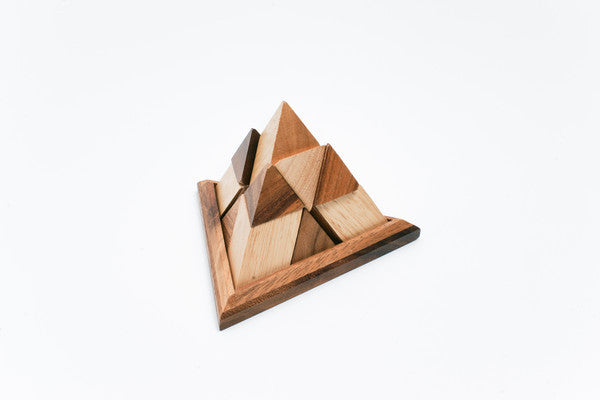
Pyramid 14 Pieces - Wooden Puzzle
Sold Out
A great gift that makes an elegant decoration for any home or office.
This gorgeous pyramid is comprised of fourteen pieces. Once taken apart- can you build it again?
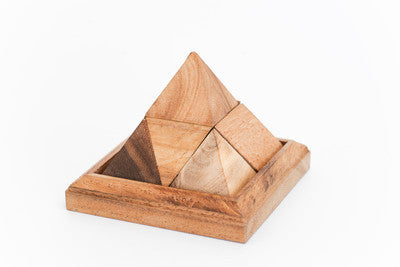
Pyramid 5 Pieces - Wooden Puzzle
Sold Out
A great gift that makes an elegant decoration for any home or office.
This gorgeous pyramid is comprised of five pieces. Once taken apart- can you build it again?
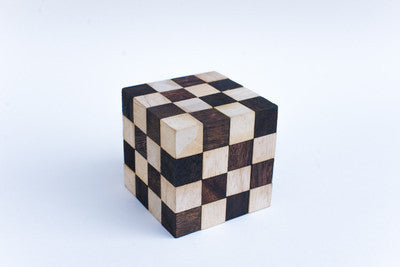
Snake Cube 4x4 - Wooden Puzzle
$15.00
Once the shape is unraveled, getting it back into a cube turns out to be much harder than it looks . Fair warning: this puzzle has 47 steps to bring it back into a cube. Starting with a 3x cube is recommended.
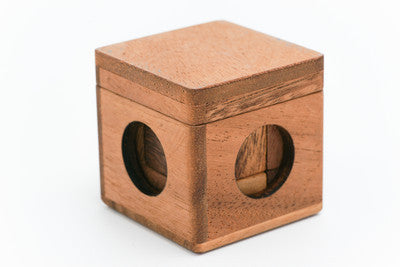
Soma in a box - Wooden Puzzle
Sold Out
Invented during a physics lecture the Soma Cube brings the fun and challenge of tangrams into the 3rd dimension.
The cube is built from 7 different pieces, creating a 3X3X3 cube. There are 240 different ways to build a solid cube.
There are as many hundreds of shapes to assemble from all the parts. Try to invent your own shapes as well.
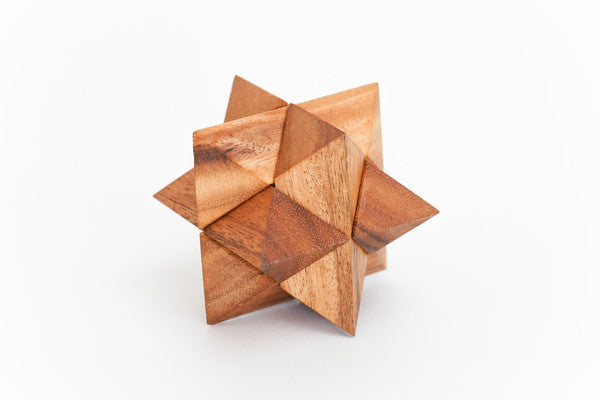
Star Puzzle - Mini
Sold Out
This is a good starting point for 3d puzzles, a fun puzzle that leaves you with a nice decoration for any desk or mantle. It is important to pay attention to how the star comes apart in order to put it back together again.
This puzzle contains 6 identical pieces. Try to assemble the pieces to a 3D star shape.
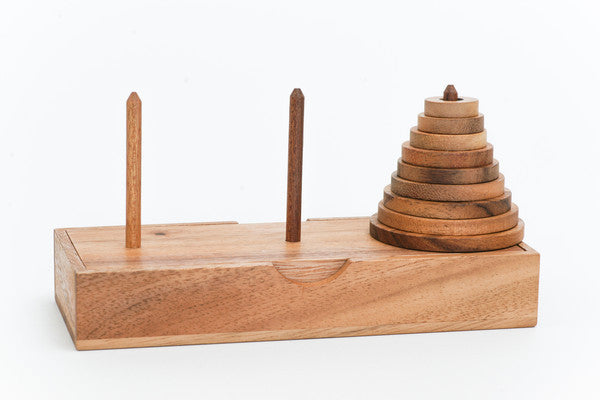
Towers of Hanoi - Wooden Puzzle
Sold Out
The tower of Hanoi (also called the tower of Brahma or the Lucas tower) was invented by a French mathematician Édouard Lucas in the 19th century. It is associated with a legend of a Hindu temple where the puzzle was supposedly used to increase the mental discipline of young priests. In the legend the young priests were given 64 gold disks stacked neatly on one of three posts. Each disk rested on a slightly larger disk. The priests' goal was to re-create the stack on a different post by moving disks, one at a time, to another post with the rule that a larger disk could never be placed on top of a smaller disk. Using mathematics, you can calculate that even when the priests found the most efficient way to solve the problem, and moved the disks at a rate of one per second, it would take almost 585 billion years to finish the job. That is more than 40 times the age of the universe!


